
Last year I sat in on a hiring conversation at my company. The candidate had spent eight years running a 40-person team in environments most of us cannot imagine. He had managed multi-million dollar systems, held a top-tier security clearance, mentored a dozen junior leaders, and made consequential decisions on a regular schedule under conditions that would make a corporate stretch project look mild. All the while, he needed to keep his cool; after all, people were looking to him to lead.
The job description he was interviewing for asked for five to seven years of relevant experience and a bachelor's degree. The conversation in the room turned into a debate about whether he was “ready” for the role.
I found the conversation frustrating; he was, as you might have guessed, an honorably-discharged Sergeant Major in the Army. That he didn’t have a bachelor’s degree was irrelevant. He’d clearly be able to get software implementations over the finish line, which is what we were hiring for. (He ultimately got the job).
Versions of this irritating conversation happen over and over throughout the entire American economy. We have a fundamental unanswered question:how does the U.S. military's twenty-year, multi-trillion-dollar talent development pipeline get recognized by an applicant tracking system designed for civilian career paths?
We must bridge that gap, and we can.
What the Country Actually Invests
As a nation, we invest just as much in building service members’ capabilities as we do in a BA’s. If anything, we invest more.
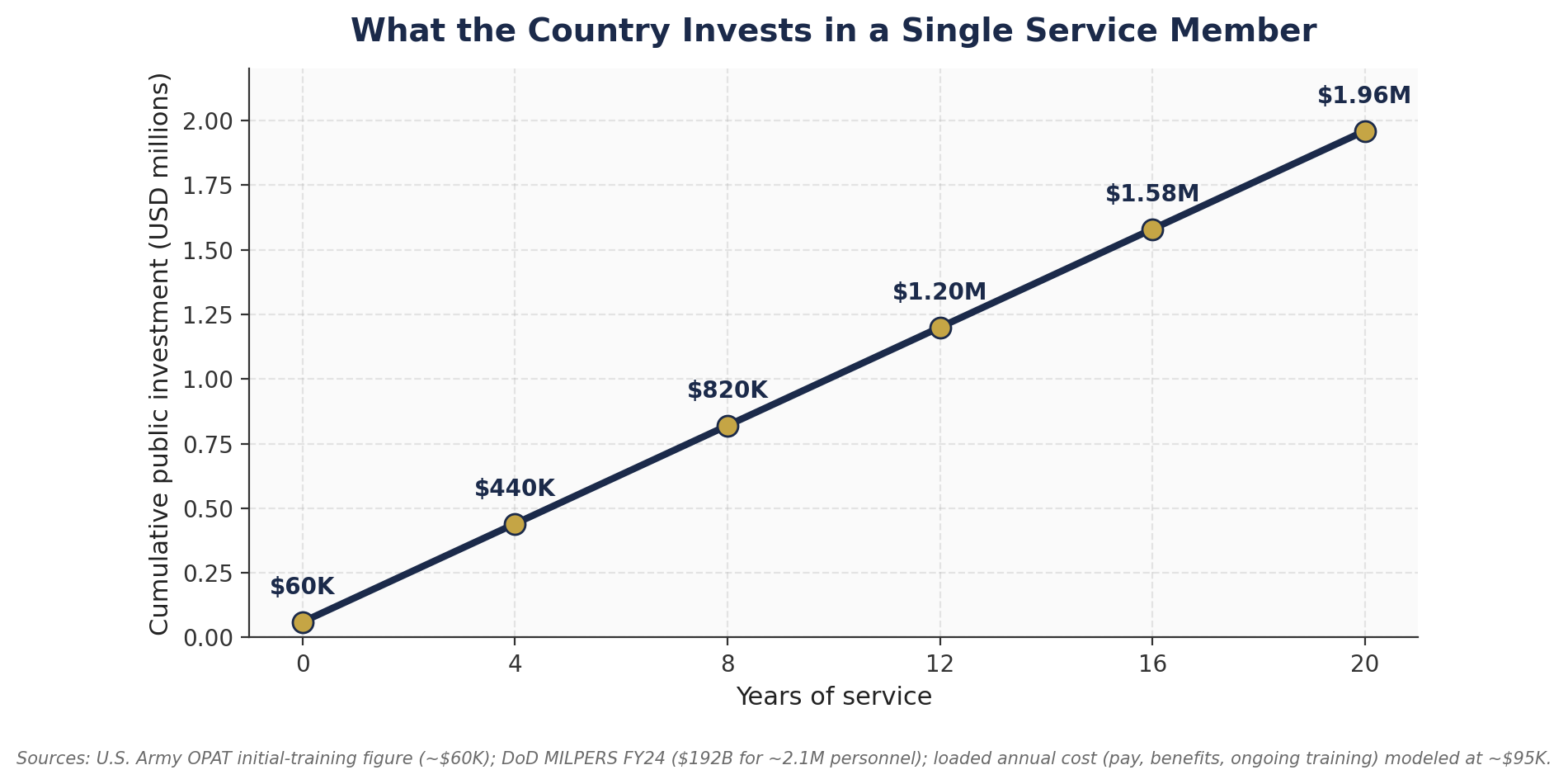
When a young person enlists in the U.S. Army, the cost to recruit, train, and move them to their first operational assignment runs to approximately $60,000 per soldier. By the time they arrive at that first duty station, they have already completed basic training, advanced individual training in a specialty, and in most cases, multiple certifications relevant to their job.
We’re just getting started. For Air Force technical specialties, follow-on tech school can run anywhere from 6 to 72 weeks. Across the services, the training community spends hundreds of hours per year on continuing education for each warfighter, not only for the role in front of them but the next role, and contingencies foreseen or unforeseen.
Add compensation and benefits. The Department of Defense's military personnel appropriation in FY2024 was approximately $192 billion, covering pay, allowances, healthcare, retirement contributions, and ongoing development. Average total pay and allowances run around $75,000 annually for an enlisted service member and roughly $149,000 for an officer, per CBO and DoD compensation analyses.
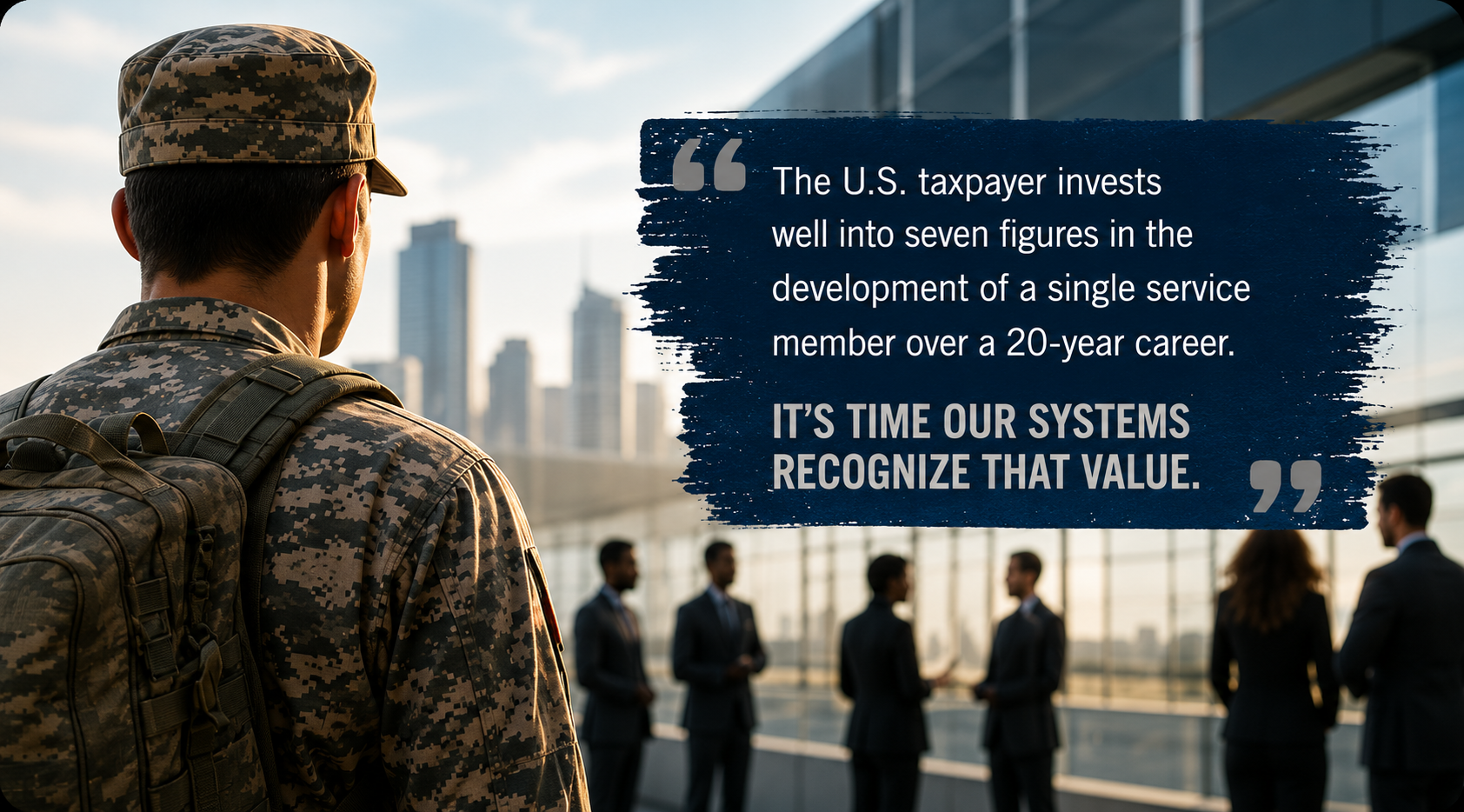
For officers, we pay even more; many of them attend one of the military’s prestigious institutions like the Army War College or the Naval Postgraduate School while in uniform, adding hundreds of thousands of dollars worth of education to the tab. Stack these numbers together and the picture is clear. Across a 20-year career, the U.S. taxpayer invests well into seven figures in the development of a single service member, broken down across initial training, follow-on schools, continuing professional development, leadership development, certifications, healthcare, and accumulated experience in the field. The chart below shows one conservative way to think about that arc.
What That Investment Produces
That pipeline produces real talent. Civilian employers consistently underestimate it (or, more accurately, their hiring systems are too inflexible to seize the opportunity). Smart companies have realized the opportunity and adjusted.
Take a typical enlisted servicemember who joins at 18. By 22, when kids with BAs have maybe led a student organization, they’ve held responsibility for equipment, people, and outcomes at a scale most of their civilian peers will not touch until their early thirties. By 26, they could be leading 30 to 50 people, accountable for systems worth tens of millions of dollars, and operating under personal accountability that few corporate environments demand.
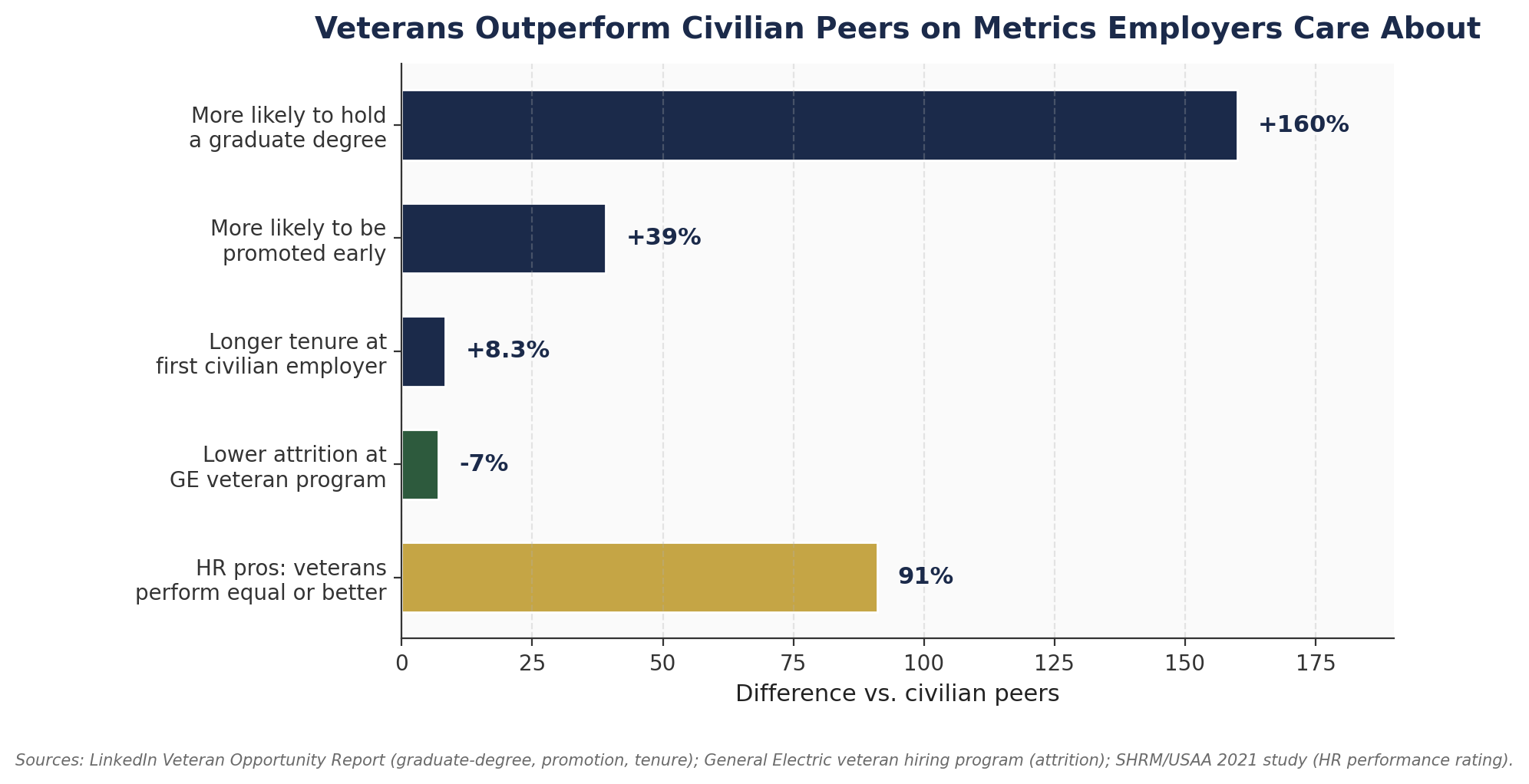
The educational attainment numbers reinforce this. According to the LinkedIn Veteran Opportunity Report, veterans are 160 percent more likely than non-veterans to hold a graduate degree, and veterans with bachelor's degrees average 2.9 times the work experience of their civilian peers.
These are not abstract numbers. They translate into people who walk into a civilian workplace already knowing how to lead a meeting, hit a deadline, and absorb a setback without losing the room.
What Employers Say When You Ask Them
The research on veteran job performance is consistent and, if you spend time in HR, almost surprising.
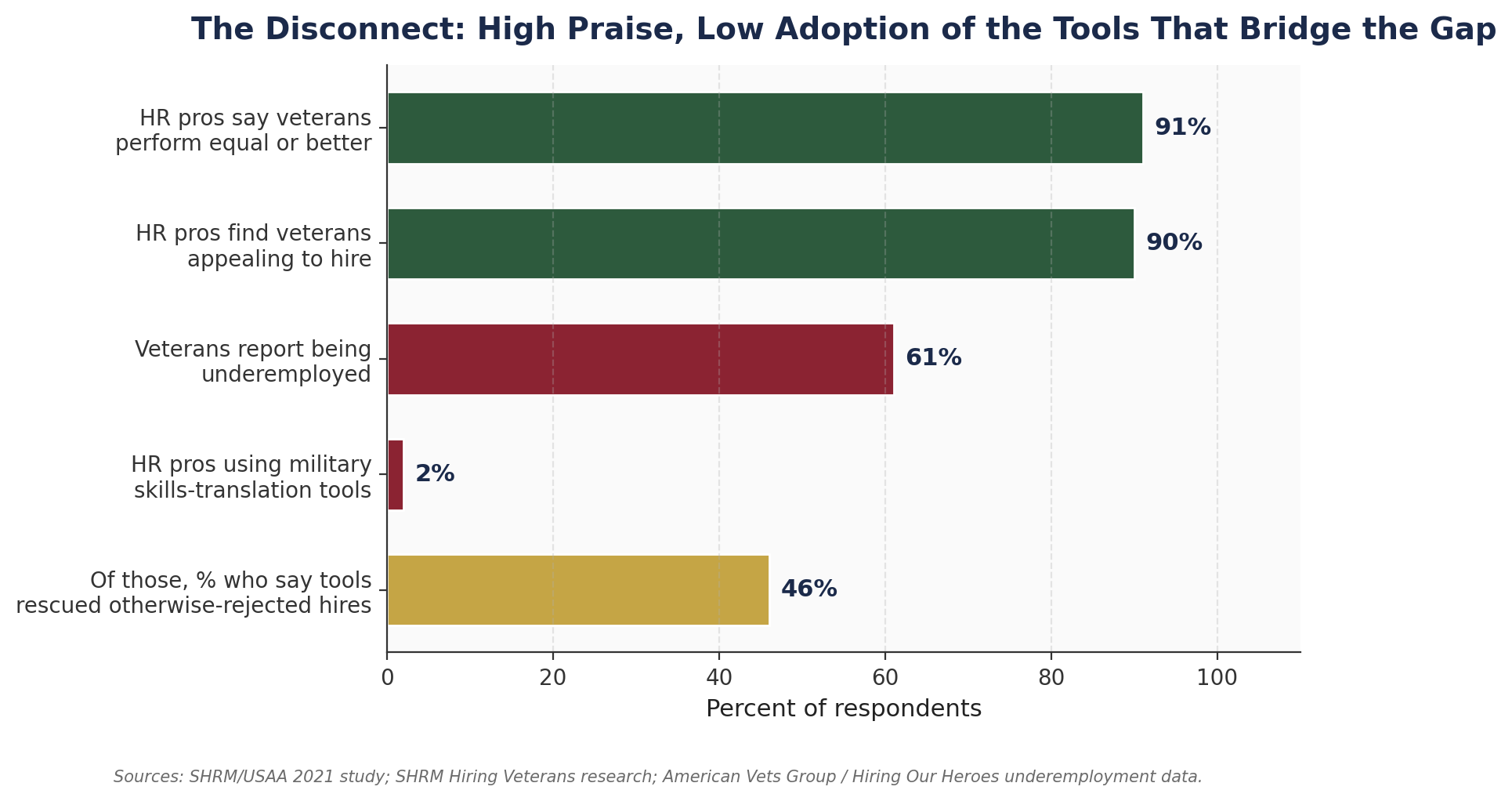
According to the Society for Human Resource Management (SHRM), 90 percent of HR professionals agree that hiring veterans is appealing to their organization, and 98 percent agree that veterans thrive in both team-based and independent roles. A 2021 SHRM and USAA study found that 91 percent of HR professionals reported veterans perform equal to or better than their civilian counterparts in terms of retention and reliability.
LinkedIn's research adds the on-the-ground numbers. Veterans are 39 percent more likely to be promoted early in their careers than non-veterans, and they stay with their initial post-service employer 8.3 percent longer. General Electric, which has run one of the country's larger veteran hiring programs, has reported a 7 percent lower attrition rate for veteran employees compared with their non-veteran peers.
The Disconnect
If the population is high-performing and the employers agree it is high-performing, you would expect the labor-market outcomes to reflect that.
They do not.
Multiple studies have found that around 61 percent of veterans report being underemployed due to a perceived mismatch between their military experience and what civilian employers ask for. Roughly 33 percent of veterans say their current job does not match their education, training, or experience. Less than half of veterans say they can effectively translate their military skills into a non-military setting.
The downstream cost is real. Underemployed veterans are about 90 percent more likely to leave their first civilian job within a year. So we have a workforce that is more educated, more experienced, more leadership-ready, and rated more highly by employers, that nonetheless lands disproportionately in roles below its potential. Something between the candidate and the role is filtering out talent the employer says it wants.
The Experience Requirements Trap
This is a systems failure. Most civilian job descriptions are not written with military backgrounds in mind. They ask for five to seven years of relevant industry experience or demonstrated success in a corporate environment. Applicant tracking systems are built to keyword-match against civilian job titles. A senior NCO who managed a $20 million logistics operation does not show up in a search for “supply chain manager.” A Marine Corps platoon commander who led 40 people through a deployment does not match “team lead, experience preferred.”
The SHRM data on translation tools is striking. Only 2 percent of HR professionals report using military skills translation tools, despite their availability. Yet within that small group, 46 percent said the tools helped them hire veterans who would otherwise have been deemed unqualified.
|
Fewer than one in fifty HR teams uses a skills translation tool. Of those that do, nearly half say it rescued a hire they would have rejected. The system, not the candidate, is the bottleneck. SHRM, Veterans Hiring Research |
Degree Inflation Makes It Worse
The Experience Requirements trap is amplified by a parallel filter: degree inflation. Since 2007, the share of U.S. job postings that require a bachelor's degree has risen by approximately 60 percent, even after controlling for changes in the mix of available jobs. Among production supervisors, 67 percent of postings now ask for a college degree, even though only 16 percent of people currently doing those jobs hold one.
For veterans, who often delay, defer, or pursue a non-traditional education path while serving, this filter does extra damage. A perfectly qualified veteran with deep operational experience, advanced certifications, and a strong credential portfolio can be auto-rejected because the resume header does not say “Bachelor of Arts.”
Encouragingly, 81 percent of employers in a recent survey said they are now looking at skills rather than degrees when filling open roles. Google, Apple, IBM, and dozens of federal contractors have removed the bachelor's requirement from most roles between 2020 and 2024. The direction is right. The pace is too slow.
What the Best Companies Are Doing
The best companies view veterans as an undervalued asset that can give them a substantial competitive advantage; they don’t think of it as marketing, let alone charity. I have watched a handful of companies make their systems more flexible to best leverage the opportunity, and a successful playbook always looks the same. They all:
- Rewrite job descriptions to focus on outcomes rather than corporate-coded experience. Say what the job needs to produce, not what title the candidate should have held before.
- Invest in skills translation, either by hiring people who speak both languages or by adopting one of the available translation tools. The SHRM data shows this works, and the minimal expense provides enormous ROI.
- Build mentorship into the first year, since the data shows that the first-year retention cliff is where most veteran hires either flourish or leave. Mentorship can help veterans bridge relatively minor cultural differences that can still determine whether they sink or swim.
SHRM found that organizations with formal veteran hiring programs were three times more likely to report themselves as effective at veteran hiring than those with no program at all.
The Personal Part
I am not a veteran. I am a father and a husband. My family has the privilege of never having to navigate the labor market with a military resume. When I think about what gets lost when a candidate with twenty years of leadership behind them is filtered out at the resume stage, I think about that as a national waste, not just a private one.
The U.S. taxpayer has spent well into seven figures developing the skills, judgment, and discipline that walk out of the gate with each separating service member. Civilian employers tell every researcher who asks that this is the kind of person they want to hire. And then, in many cases, we hand the screening of those people to a tool that does not recognize the work they did.
Rethinking experience requirements is not charity or lowering the bar; it is about adjusting HR systems to bring in the talent companies actually need, rather than hewing to outdated descriptions and input factors. Yes, it requires flexibility, but not all that much. It requires reading into what a candidate actually brings to the table and being willing to learn to speak their language. Or even just running their resume through a free translator.
Our country spent hundreds of thousands of dollars making vets an asset, and that asset is there for the taking. There is no reason companies shouldn’t leverage the opportunity.
Sources and References
- U.S. Army, OPAT reduces trainee attrition (initial training cost data)
- Today's Military, Education and Training
- Peter G. Peterson Foundation, Budget Basics: National Defense (FY24 MILPERS)
- Congressional Budget Office, Costs of Military Pay and Benefits
- LinkedIn, 2019 Veteran Opportunity Report (Promotion, Education, Tenure)
- SHRM, Veterans as America's Hidden Talent Advantage
- SHRM, Barriers and Solutions for Hiring Veterans
- SHRM Research Underscores Veterans' Value in the Workforce
- American Vets Group, Veteran Underemployment Brief
- Hire Heroes USA, Improving Retention Rates Among Veteran Employees
- FREOPP, How Unnecessary College Degree Requirements Hurt the Working Class
- The Hill, Breaking the Paper Ceiling on Federal Hiring
- Hiring Our Heroes, U.S. Chamber of Commerce Foundation