
In Silicon Valley, we talk about the future of work as if it just got invented. Remote teams. Portable careers. Skills-first hiring. The gig economy. Most of these so-called trends had their breakthrough moment somewhere between March 2020 and the end of 2024. Companies, including ones I have run and invested in, redesigned everything from their hiring funnels to their benefits packages to fit a workforce that suddenly looked different.
But here is the thing: none of these trends are new to military families. They have been living each of them, often out of pure necessity, for decades. If you want a preview of what the American workforce will look like in 2035, you do not need a futurist. You need to spend an afternoon with a military spouse.
This article is about what we get wrong when we treat military families as a special-case workforce, when they are in fact a leading indicator of where the entire labor market is going.
What “The Future of Work” Now Means
When researchers and HR leaders talk about the future of work, they tend to mean a few specific things: work that is location-agnostic, careers that are portable across employers and states, hiring decisions made on skills rather than credentials, households that depend on two incomes, and income that comes increasingly from freelance, contract, or self-employed channels.
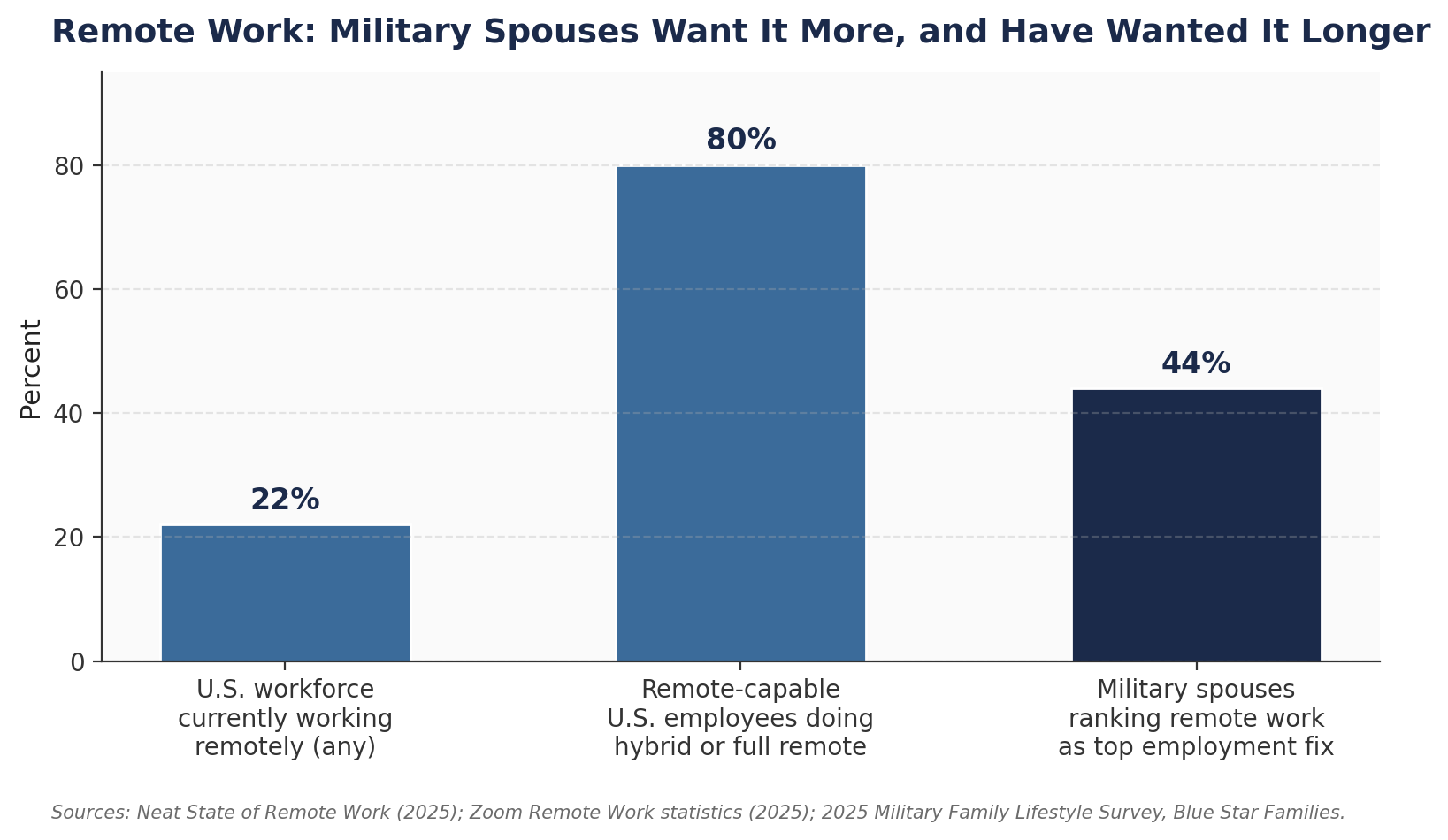
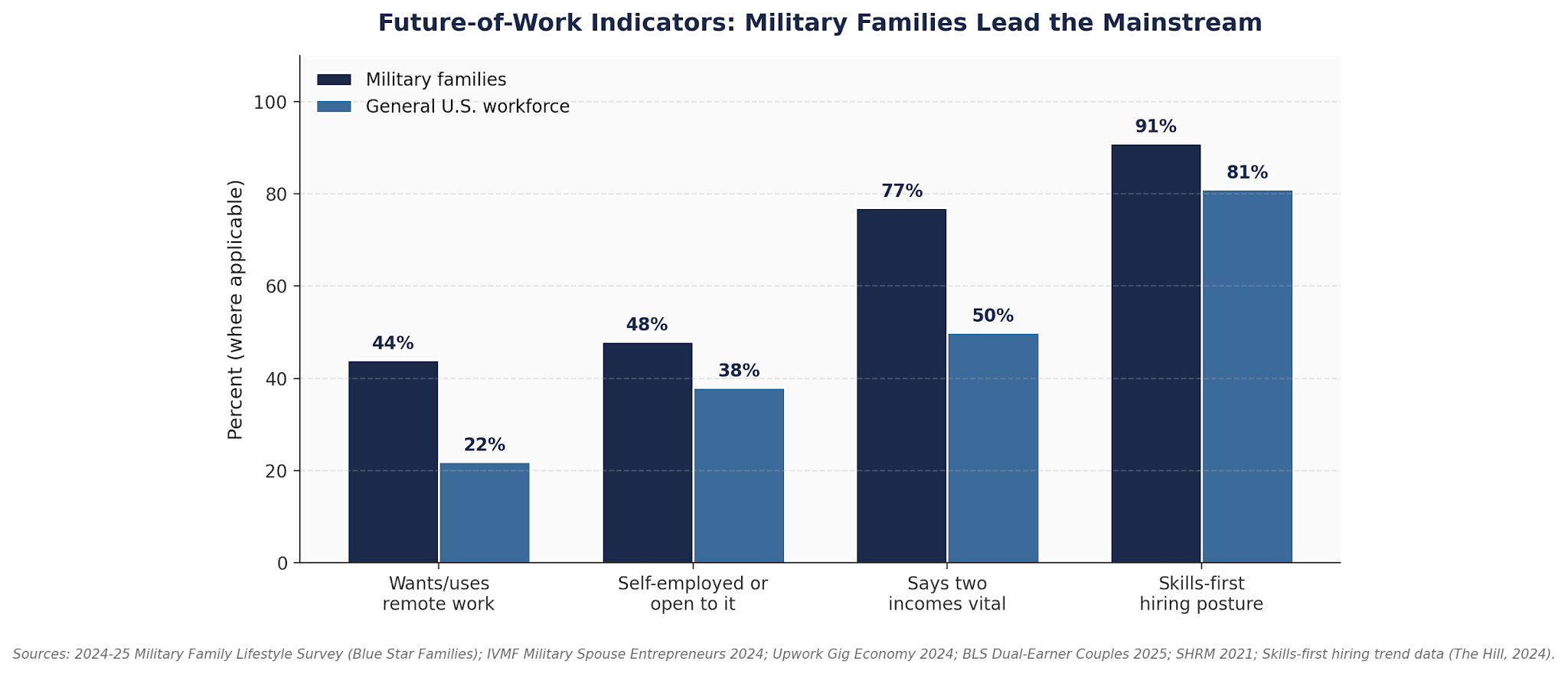
Each of these has a number behind it. Roughly 22 percent of the U.S. workforce (about 32.6 million Americans) works remotely. About 80 percent of remote-capable employees are now hybrid or fully remote. Approximately 38 percent of the workforce did some form of freelance work in 2024. About 49.6 percent of married couples now have both spouses employed. And 81 percent of employers say they are hiring for skills rather than degrees (they say they are, anyways; whether they actually are is another matter).
These are big, recent, headline numbers. Each describes a shift the mainstream workforce is in the middle of digesting. And each describes life conditions military families have been operating in for a long time.
Pattern One: Remote Work
Military families do not get to optimize their employment around geography. The geography is assigned. So for years before remote work became a corporate keyword, military spouses were finding ways to keep careers alive across base relocations. They built freelance practices that could move. They negotiated remote arrangements with employers in their previous state. They went into industries where the work was the work, no matter where you sat.
When the 2025 Military Family Lifestyle Survey asked active duty spouses what would best address their employment concerns, 44 percent named remote work opportunities as the top answer, by a wide margin. Even after the post-pandemic shift, only about 22 percent of all U.S. workers are remote today, and 24 percent of new job postings are hybrid. Military spouses are not catching up to a trend. They were the first cohort to insist on it.
Pattern Two: Portable Careers
A career that does not move with you is, for a military family, no career at all. So military spouses have been pushing for portability long before the corporate world cared about it.
Two policy shifts make the point. In December 2024, an updated version of the Servicemembers Civil Relief Act made professional licenses portable across state lines for service members and their spouses. In early 2025, federally employed military spouses were categorically exempted from the federal return-to-office mandate.
These policies may sound technical, but they are a massive legal concession to reality (though the mechanics of such flexibility for military families are very much still a work in progress.). The workforce of military families cannot be locked to a fixed location, and the legal and benefit systems are starting to accept that. The broader workforce will eventually need the same flexibility. Portable health coverage, portable retirement, portable credentialing. We are nibbling at the edges of these in the civilian world.
For military families, however, they are essential and non-negotiable; without them, such families will struggle to make ends meet.
Pattern Three: Skills Over Titles
Here is a phrase that gets repeated in startup hiring conversations now: we hire for skills, not credentials.
About 81 percent of employers say they are looking at skills rather than degrees. IBM has eliminated the bachelor's requirement on roughly half of its U.S. roles. Google, Apple, Accenture, and dozens of large federal contractors have done similar things. To be clear, most companies are still hiring for degrees rather than skills, but the trend is going in the right direction, and for good reason: research suggests skills-based hiring is five times more predictive of job performance than hiring for education.
Military families have lived this their whole working lives. A teacher with a Texas license who moves to Maryland does not magically gain a Maryland license, but their teaching ability does not change either. Skills-based hiring is not a philosophical preference for these families. It is the only kind of hiring that gives them a fair shot.
Pattern Five: Freelance and Self-Employed
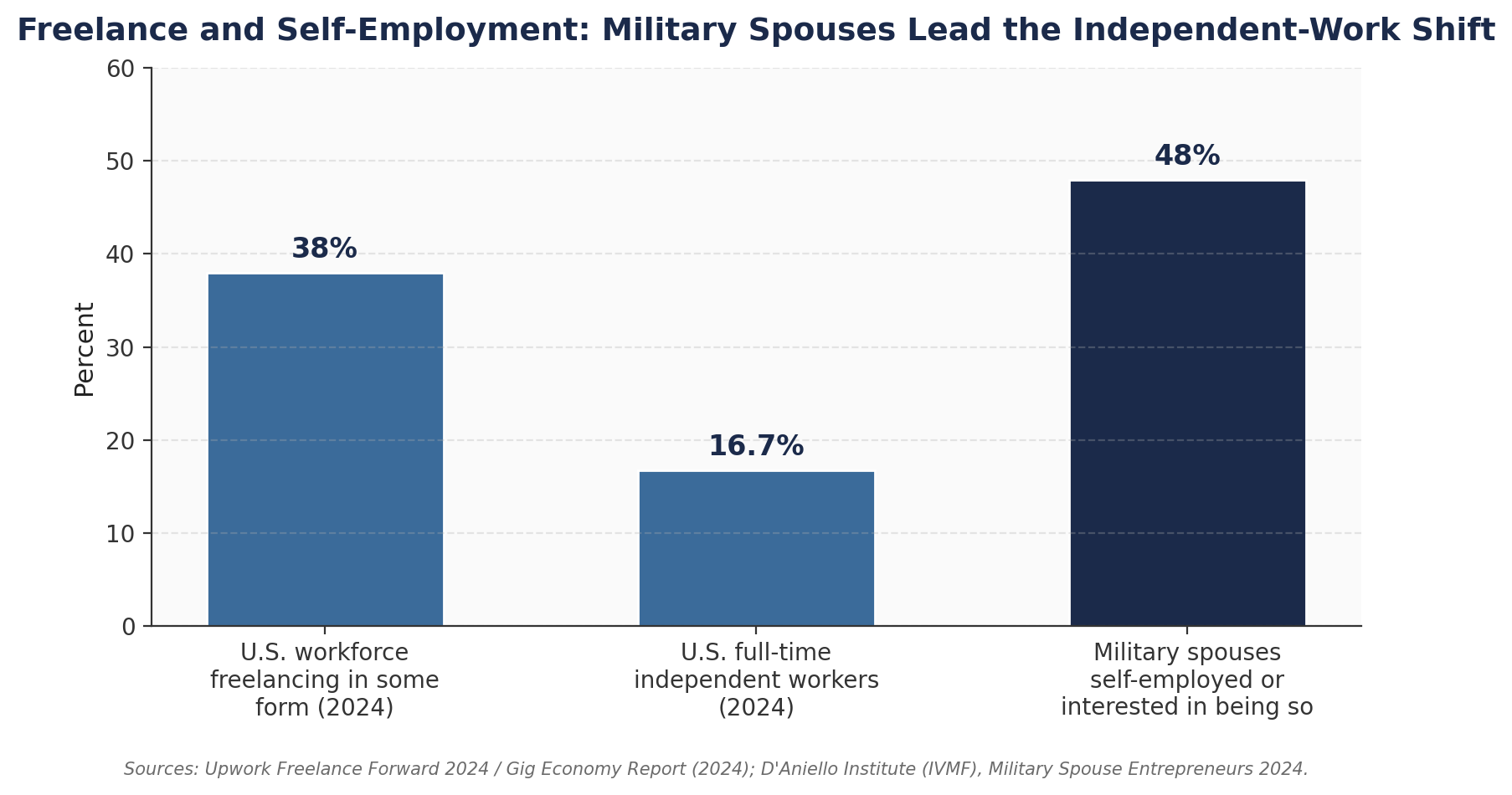
The fastest-growing slice of the U.S. labor force is independent workers. About 38 percent of the U.S. workforce did some freelancing in 2024, roughly 76 million Americans. Full-time independent workers more than doubled between 2020 and 2024. The same Upwork research projects roughly half the U.S. workforce will freelance by 2027.
Military families are well ahead of this curve. According to the D'Aniello Institute for Veterans and Military Families, 48 percent of military spouses are either self-employed or actively interested in being entrepreneurs. They are not opting in for ideological reasons. They are opting in because traditional employment, with its location lock, 9-to-5 demands, and credential reset every two years, does not fit their life.
|
The workforce of the future does not look like the workforce of 1995. And the workforce of 1995 was already the wrong model for military families. They have been telling us this. Author's note |
What We Should Learn
If you accept that military families are a leading indicator, the implications for civilian employers, lawmakers, and product designers are concrete.
- Build for portability. The benefits, tools, and policies that work for military families, including remote-first hiring, license recognition, and skills translation, are precisely the policies that will distinguish good employers from bad ones over the next decade. Get to them now while it is a competitive advantage rather than a baseline expectation.
- Treat self-employment as a serious career, not a fallback. Forty-eight percent of military spouses see entrepreneurship as a real option, and roughly half the U.S. workforce will be freelancing within five years. Civilian benefits, lending, and labor protections all assume W-2 employment is normal. They are heading toward not being.
- Stop treating military family programs as charity. The hiring program, the spouse career path, the remote-work-friendly policy: these are not concessions. They are early access to the population that will shape what your full workforce expects in 2035.
The Personal Part
I am not a veteran. I am a husband and a father, and someone who has spent a long time in tech trying to predict what the workforce will look like next. The hardest part of that prediction work is figuring out where to look. The mainstream is usually a lagging indicator. The people pushing on the edges of the system, because they have to, are the leading indicator.
Military families are pushing on every edge of the modern workplace. They cannot wait for remote work to become a corporate preference. They cannot wait for license portability to become a state-by-state political win. They cannot wait for “skills over credentials” to filter down from the largest tech employers to the rest of the labor market.
If we listen to them, we end up with a workforce that works for more people. If we do not, we keep building tomorrow's labor systems on yesterday's assumptions. The country has trained these families. They have already drawn the map. We should follow it.
Sources and References
- Neat, The State of Remote Work: 2025 Statistics
- Zoom, 25 Must-Know Remote Work Statistics for 2025
- Robert Half, Remote Work Statistics and Trends
- Upwork, Gig Economy Statistics and Market Trends
- Blue Star Families, Military Spouse Employment Initiative (2025 MFLS)
- Blue Star Families, 2024 Military Family Lifestyle Survey Release
- U.S. Department of Justice, 2025 Update on Portability of Professional Licenses
- Military Times, Federal military spouse workers exempt from RTO order
- Index.dev, Skills Over Degrees: How Google and IBM Hire Top Talent
- AssessCandidates, Best Practices for Skills-Based Hiring
- The Hill, Breaking the Paper Ceiling on Federal Hiring
- U.S. Bureau of Labor Statistics, Both spouses employed in about half of married-couple families (2025)
- D'Aniello Institute for Veterans and Military Families, Military Spouse Entrepreneurs 2024